
Talking Tariffs with CSC…
Adding on to our last week update, things remain very fluid and unpredictable, we will continue to update on a weekly basis.
Big Date August 1, full tariffs MAY be enforced! Friday is the deadline for countries to make a deal or face reciprocal tariffs.
Some deals have been struck in the last week, the biggest is with the EU:
U.S.–EU Tariff Deal: 15 % Tariffs Imposed, Trade War Averted
- On July 27, 2025, President Trump and EU Commission President Ursula von der Leyen struck a major trade deal in Scotland, setting a 15 % import tariff on most EU goods—down from a previously threatened 30 % rate.
- The agreement includes EU commitments to purchase $750 billion in U.S. energy and $600 billion in U.S. investments over the upcoming years.
- Certain strategic products—such as aircraft components, generic drugs, semiconductors, and chemicals—are exempted under a "zero-for-zero" clause.
- Steel and aluminum tariffs remain at 50 %, unchanged by this deal.
- Many analysts in Europe characterize the deal as asymmetric and heavily in the U.S.'s favor, and worry about its implications for EU economic sovereignty.
U.S. - China Tariff
The current truce, which reduces U.S. reciprocal tariffs to 10 % (from 145 %) and China's to 10 % (from 125 %), is set to expire on August 12, 2025. Extension is considered likely, though no final decision has been made yet.
The countries that directly impact our industry outside of China are Pakistan, India, and Bangladesh. At this moment, no deal has been struck. If a 30% or 40% tariff goes into effect on Friday, this will be a significant cost increase to our core products. If we stay at the current 10% or go to a 15% tariff, we are looking at a 6 to 10% cost increase on these products.
At present, the U.S. dollar trades at approximately €0.86 to €0.87, with the euro valued around $1.16 to $1.17 USD. That aligns with broader trends of recent euro appreciation and relative dollar softness, shaped by tariff developments and investor positioning. The U.S. Dollar to the Euro has been weakening all year, but with the apparent new trade deal, it has started to strengthen.
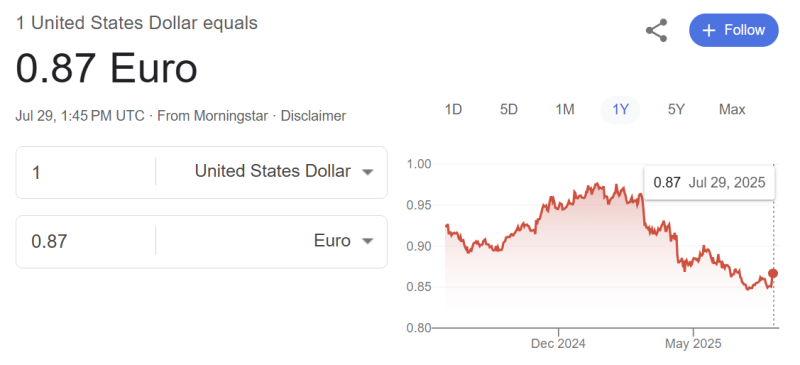
What is the impact of a weaker $, versus a stronger $:
Key Economic Effects of a Weaker U.S. Dollar
✅ 1. U.S. Exports Become Cheaper
- American goods and services become more affordable to foreign buyers.
- This can boost exports, improving the trade balance and helping U.S. manufacturers, farmers, and multinationals.
- For example, a weaker dollar makes Boeing aircraft, Apple products, or Midwest corn cheaper for buyers in Europe or Asia.
❌ 2. Imports Become More Expensive
- Goods brought into the U.S.—like electronics, clothing, or auto parts—cost more in dollar terms.
- This can increase inflation, especially for import-heavy categories like consumer electronics, oil, and food.
CSC Supplier updates due to Tariffs:
We have new updates from suppliers this week; most have already put in something for known tariffs and are now waiting for the final tariffs to go into effect.
Several legal challenges are going on that could turn all of this off. We will see if these make any impact.
I will update again next week. This will be after the deadline. We should have a clearer vision of what is going on!
Questions? Contact Jeff Landry
Disclaimer: The information provided in this update reflects the thoughts and opinions of Jeff Landry, CSC’s Executive Director, and is based on publicly available sources. It is intended solely for the purpose of education and providing value to CSCNetwork members. This content should not be interpreted as legal, financial, or policy advice.